
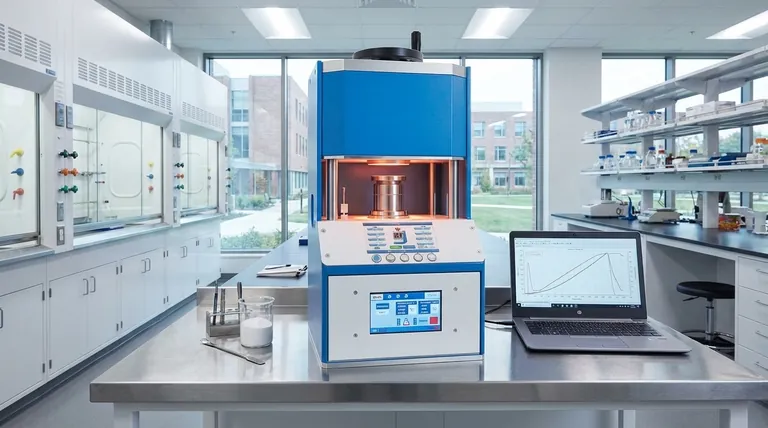
Il controllo simultaneo della pressione meccanica e dell'energia termica è il requisito fondamentale per il processo di sinterizzazione a freddo (CSP). Una pressa idraulica con funzionalità di riscaldamento è essenziale perché guida il meccanismo unico di dissoluzione-precipitazione, consentendo ai materiali di densificarsi a temperature significativamente inferiori (tipicamente <300°C) rispetto alla sinterizzazione convenzionale.
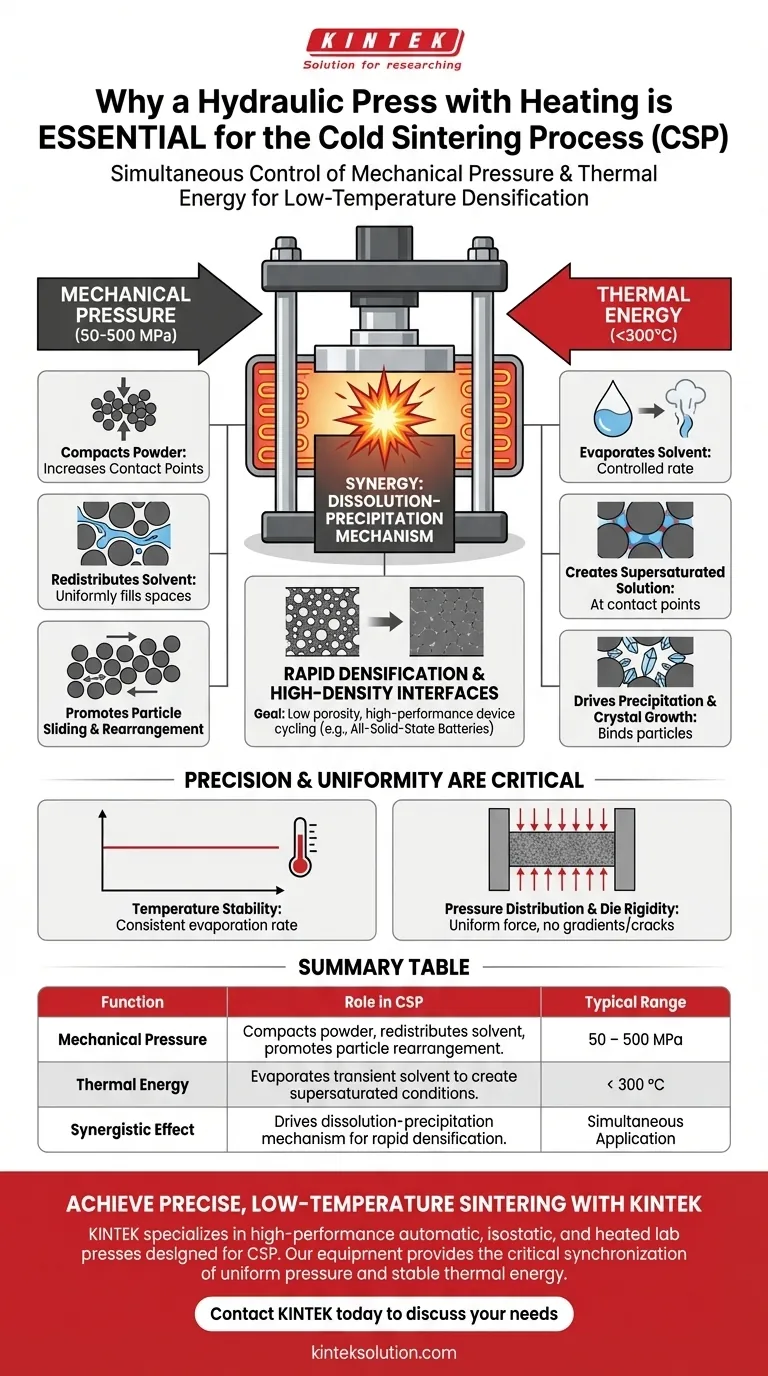
Nel CSP, la pressa idraulica funziona più che come uno strumento di formatura; agisce come un reattore che forza un cambiamento di fase. Applicando alta pressione (50–500 MPa) insieme a calore controllato, l'apparecchiatura innesca l'evaporazione dei solventi transitori per creare le condizioni di sovrasaturazione necessarie per un rapido legame delle particelle e la crescita dei cristalli.
La meccanica della sinterizzazione a freddo
Per capire perché questa specifica attrezzatura è irrinunciabile, bisogna esaminare come il CSP lega chimicamente e meccanicamente le particelle. Il processo si basa su una sinergia che non può essere ottenuta se pressione e calore vengono applicati separatamente.
Il ruolo della pressione meccanica
Nella fase iniziale, la pressa idraulica applica una forza significativa, tipicamente compresa tra 50 e 500 MPa. Questa pressione svolge tre distinte funzioni fisiche.
In primo luogo, compatta le particelle di polvere, aumentando drasticamente il numero di punti di contatto tra di esse.
In secondo luogo, la pressione forza il solvente acquoso transitorio a ridistribuirsi uniformemente negli spazi interstiziali (gli interstizi) tra le particelle.
In terzo luogo, agendo in sinergia con l'effetto lubrificante del solvente, la pressione promuove lo scorrimento e il riarrangiamento delle particelle. Questo stabilisce una base strutturale densa richiesta per le fasi chimiche successive.
Il ruolo dell'energia termica
Mentre la pressa mantiene la pressione, l'elemento riscaldante aumenta la temperatura a un livello controllato, solitamente inferiore a 300°C.
Questo basso calore è fondamentale per evaporare il solvente transitorio all'interno della polvere compattata. Man mano che il solvente evapora, crea una soluzione sovrasatura specificamente nei punti di contatto tra le particelle.
Questo stato di sovrasaturazione guida la precipitazione del materiale e la crescita dei cristalli. Questa reazione chimica è ciò che effettivamente lega le particelle, portando a una rapida densificazione.
Ottenere interfacce ad alta densità
Per applicazioni come le batterie all-solid-state, l'obiettivo è creare un materiale denso a bassa impedenza.
Applicando una pressione uniforme durante il riscaldamento, la pressa minimizza la porosità interna e massimizza i percorsi di conduzione ionica.
Ciò si traduce in un'interfaccia solido-solido stretta tra i componenti (come elettroliti ed elettrodi), che è fondamentale per cicli di dispositivi ad alte prestazioni.
L'importanza della precisione e dell'uniformità
Mentre la combinazione di calore e pressione è vitale, anche la qualità del controllo è ugualmente importante. L'uso di una pressa standard con una pistola termica esterna, ad esempio, probabilmente porterebbe al fallimento a causa della mancanza di stabilità.
Stabilità della temperatura
È necessaria una gestione precisa della temperatura per controllare la velocità di evaporazione del solvente.
Se la temperatura fluttua, la velocità di precipitazione sovrasatura diventa incoerente, il che può rallentare il tasso di densificazione o portare a un legame non uniforme.
Distribuzione della pressione e rigidità dello stampo
La pressa idraulica deve funzionare in sinergia con un set di stampi di alta qualità per trasmettere accuratamente la forza macroscopica.
Se il set di stampi manca di rigidità o precisione, la distribuzione della pressione all'interno del campione sarà non uniforme.
Questa pressione non uniforme può causare gradienti di densità o microfratture, compromettendo l'integrità strutturale del dispositivo finale.
Fare la scelta giusta per il tuo obiettivo
La scelta della giusta configurazione della pressa idraulica dipende dai requisiti specifici della tua applicazione di scienza dei materiali.
- Se il tuo focus principale è la ricerca fondamentale: Dai priorità a una pressa con controlli di temperatura e pressione altamente granulari per sperimentare le soglie precise di dissoluzione-precipitazione per nuovi materiali.
- Se il tuo focus principale è la fabbricazione di dispositivi (ad es. batterie): Concentrati su un sistema che garantisca un'estrema uniformità della pressione e rigidità dello stampo per garantire interfacce a bassa porosità e prestazioni elettrochimiche coerenti.
Il successo nella sinterizzazione a freddo è definito dalla capacità di sincronizzare perfettamente la compattazione meccanica con la precipitazione chimica.
Tabella riassuntiva:
| Funzione | Ruolo nel CSP | Intervallo tipico |
|---|---|---|
| Pressione meccanica | Compatta la polvere, ridistribuisce il solvente, promuove il riarrangiamento delle particelle. | 50 – 500 MPa |
| Energia termica | Evapora il solvente transitorio per creare condizioni di sovrasaturazione per il legame. | < 300 °C |
| Effetto sinergico | Guida il meccanismo di dissoluzione-precipitazione per una rapida densificazione e bassa porosità. | Applicazione simultanea |
Ottieni una sinterizzazione precisa a bassa temperatura per la tua ricerca sui materiali avanzati o la fabbricazione di dispositivi.
KINTEK è specializzata in macchine per presse da laboratorio ad alte prestazioni, tra cui presse da laboratorio automatiche, presse isostatiche e presse da laboratorio riscaldate progettate per processi come la sinterizzazione a freddo. La nostra attrezzatura fornisce la sincronizzazione critica di pressione uniforme ed energia termica stabile richiesta per il successo.
Pronto a migliorare i tuoi risultati CSP con attrezzature affidabili e di precisione? Contatta KINTEK oggi stesso per discutere le tue specifiche esigenze di laboratorio e come le nostre soluzioni possono guidare la tua innovazione.
Guida Visiva
Riferimenti
- Yu Tong, Hongtao Zhang. Current understanding and applications of the cold sintering process. DOI: 10.1007/s11705-019-1832-1
Questo articolo si basa anche su informazioni tecniche da Kintek Solution Base di Conoscenza .
Prodotti correlati
- Macchina pressa idraulica riscaldata ad alta temperatura automatica con piastre riscaldate per il laboratorio
- Pressa Idraulica Riscaldata Automatica con Piastre Calde per Laboratorio
- Macchina automatica riscaldata della pressa idraulica con i piatti riscaldati per il laboratorio
- Pressa Idraulica da Laboratorio Riscaldata 24T 30T 60T con Piastre Calde per Laboratorio
- Macchina di stampa idraulica riscaldata con i piatti riscaldati per la stampa calda del laboratorio della scatola di vuoto
Domande frequenti
- Qual è la funzione di una pressa idraulica da laboratorio con piastre riscaldate nelle batterie a stato solido (SSE)? Migliorare la densità e la conducibilità della batteria
- Quali sono i requisiti per la pressatura degli elettrodi con liquidi ionici ad alta viscosità come EMIM TFSI? Ottimizzare le prestazioni
- Come una pressa idraulica riscaldata da laboratorio facilita la preparazione del campione PBN per WAXS? Ottenere una diffrazione a raggi X precisa
- Quali sono le applicazioni industriali delle presse idrauliche riscaldate? Padroneggia calore e forza per la produzione di precisione
- Perché è necessaria una pressa idraulica da laboratorio con piastre riscaldanti per film di PLA/TEC? Ottenere un'integrità precisa del campione



















